21 AI models, one browser tab
Chat, summarisation, code, text-to-speech, speech recognition, vision, and image generation. All running locally in your browser.
The full catalogue
Unwrite LLM ships 21 models across six categories. Every one of them downloads to your browser and runs locally. No server, no API key, no data leaving your device.
Here is the complete list, smallest download first.
| Model | Parameters | Download | Type |
|---|---|---|---|
| Kokoro 82M | 82M | ~92 MB | Text-to-speech |
| SmolLM2 135M | 135M | ~118 MB | Chat |
| LFM2.5 350M | 350M | ~255 MB | Chat |
| SmolLM2 360M | 360M | ~273 MB | Chat |
| Gemma 3 270M | 270M | ~273 MB | Chat |
| Florence 2 Base | 230M | ~332 MB | Vision |
| Qwen 3.5 0.8B | 0.8B | ~470 MB | Chat |
| Qwen 3 0.6B | 0.6B | ~570 MB | Chat |
| LaMini Flan-T5 248M | 248M | ~589 MB | Instruction following |
| Qwen 3.5 0.8B Uncensored | 0.8B | ~647 MB | Abliterated chat |
| Qwen 3 0.6B Abliterated | 0.6B | ~648 MB | Abliterated chat |
| Gemma 3 1B | 1B | ~764 MB | Chat |
| BART Large CNN | 406M | ~950 MB | Summarisation |
| Llama 3.2 1B | 1.24B | ~1.1 GB | Chat |
| Qwen 2.5 1.5B | 1.5B | ~1.2 GB | Chat |
| Qwen 2.5 Coder 1.5B | 1.5B | ~1.3 GB | Code |
| Granite 4.0 1B Speech | 1B | ~1.5 GB | Speech recognition |
| SmolLM3 3B | 3B | ~2.1 GB | Reasoning |
| Phi 3.5 Mini | 3.8B | ~2.3 GB | Chat |
| Janus Pro 1B | 1B | ~3.0 GB | Image generation |
| Gemma 4 E2B | 2.3B | ~3.4 GB | Multimodal |
All sizes are approximate. Quantised formats keep downloads smaller than the raw parameter count would suggest.
Chat models: honest comparisons
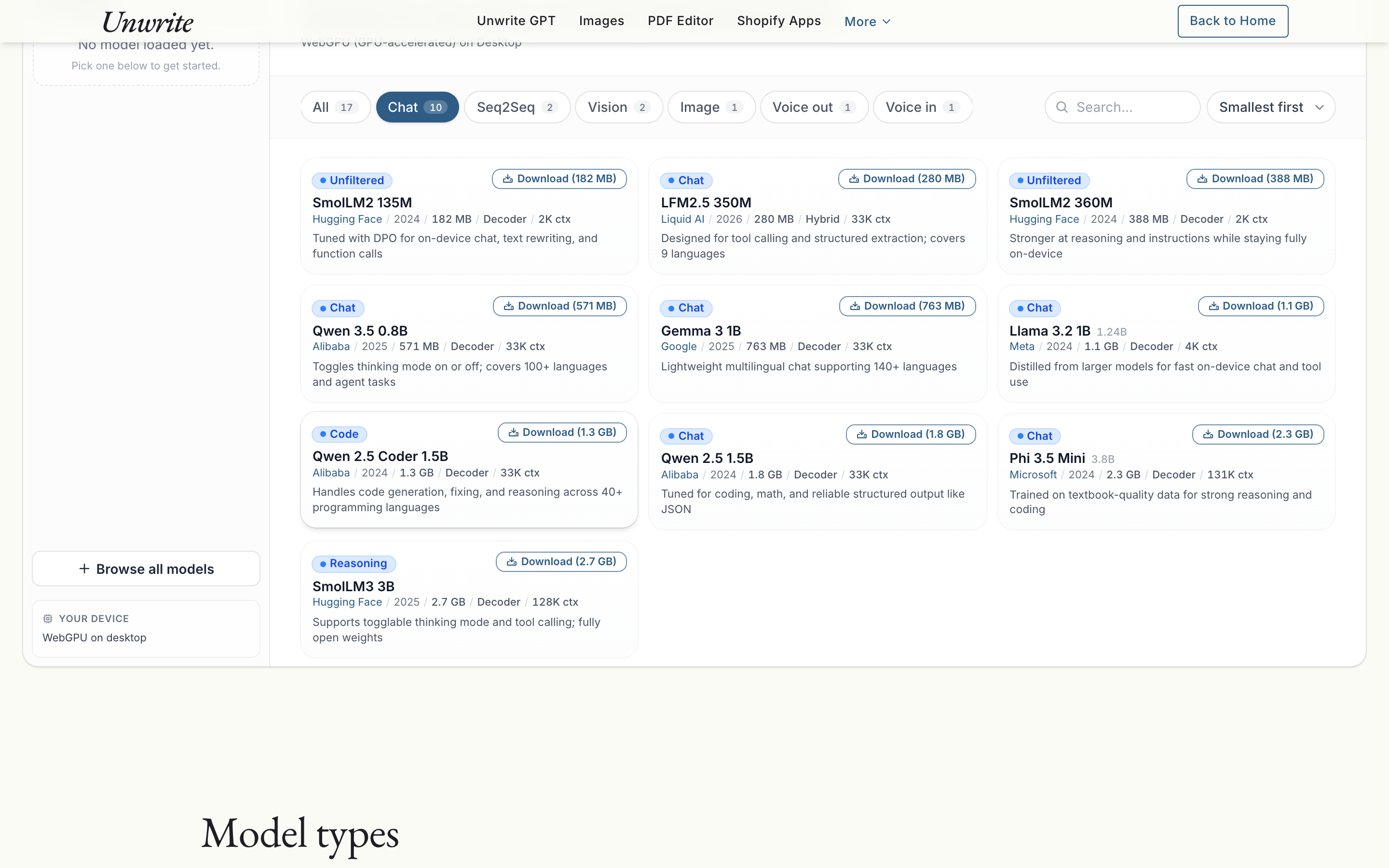
Not all 1B models are equal. Here is what to expect. The Chat filter on the picker narrows the grid to the chat-tagged rows.
SmolLM2 (135M and 360M)
The smallest chat options. They respond almost instantly and download fast. Good for testing, quick throwaway questions, or machines without much horsepower. Do not expect nuanced answers. The 135M model in particular will produce incoherent output on anything beyond simple prompts. Gemma 3 270M sits in the same size band (~273 MB) with a 32k context window, which is the one to try if you want a tiny Gemma rather than SmolLM2.
LFM2.5 350M
Liquid AI's small hybrid model, and the best value per megabyte in the catalogue. It is built for tool calling and structured extraction rather than open-ended conversation, it covers 9 languages, and it carries a 32k context window in 255 MB. If you want structured JSON out of a tiny model, start here.
Qwen 3 0.6B, Qwen 3.5 0.8B, and Qwen 2.5 1.5B
Solid mid-range options. Official Qwen3 0.6B is the aligned sibling of the heretic row, with togglable thinking and a 40k context window in 570 MB. The 3.5 0.8B covers 100+ languages in 470 MB, which makes it the one to try first if you are unsure. The 2.5 1.5B handles instructions well and is tuned for coding, maths, and reliable structured output like JSON.
Gemma 3 1B
Google's lightweight entry, with 140+ languages and a 32k context window in 764 MB. It follows instructions more reliably than most models at this size and produces cleaner prose. A good default for general chat. Gemma 3 270M is the same family at about a third of the download.
Llama 3.2 1B
Meta's distilled model, aimed at fast on-device chat and tool use. Its 4k context window is the smallest of the modern chat models here, so keep prompts focused rather than feeding it long documents.
Phi 3.5 Mini (3.8B)
Microsoft's compact model, and the largest in the catalogue by parameter count. Trained on textbook-quality data, so it is strong at structured tasks like code generation and step-by-step reasoning. It also carries a 131k context window. Inference is slow on CPU. WebGPU makes a real difference here.
SmolLM3 3B
Fully open weights, a togglable thinking mode, and tool calling, with a 128k context window. This is the one to reach for when you want the model to show its working rather than answer immediately.
Qwen 2.5 Coder 1.5B: code
A dedicated coding model covering 40+ programming languages, for generation, fixing, and reasoning about code. At 1.3 GB it is one of the better ratios of capability to download in the list, and it will happily hold a whole file in its 32k context.
LaMini Flan-T5 and BART: the sequence-to-sequence pair
Two older encoder-decoder models that do one job each and do it well.
LaMini Flan-T5 248M was fine-tuned on 2.58M instructions. It is not a conversationalist. Give it a single clear instruction and it answers, quickly, in 589 MB.
BART Large CNN is a dedicated summariser, fine-tuned on CNN and DailyMail article-summary pairs. Paste in an article and it produces a short news-style summary. Both models cap out at a 1024-token context, so they work on passages rather than documents.
Kokoro 82M: 54 voices, 8 languages
Kokoro is genuinely impressive for a browser-based text-to-speech engine. The voice quality is natural, with proper intonation and pacing that does not sound robotic.
54 voices across English (American and British), French, Spanish, Italian, Portuguese, German, Japanese, and Korean. You pick a voice, type or paste text, and it generates audio locally. At 92 MB it is also the fastest thing in the catalogue to download.
The output is good enough for draft narration, accessibility testing, or just hearing how your writing sounds out loud. It is not broadcast quality, but it is far better than the flat monotone you might expect from a browser-based tool.
IBM Granite 4.0 1B Speech: speech recognition
Granite handles speech-to-text, and it also translates across 6 languages. Feed it audio from your microphone or upload a file and it transcribes locally. It ranked #1 on the OpenASR leaderboard, and it shows: accuracy on clear speech is well beyond what browser transcription used to manage.
The catch is the download. At around 1.5 GB it is one of the heavier models here, so it is worth loading only when you actually have audio to run through it. Once it is cached, transcription is quick.
Florence 2 Base: vision
Florence 2 analyses images. Upload a photo and it can caption it, detect objects, run OCR, or ground a phrase against a region of the picture. One 332 MB model covers all four tasks.
It is fast rather than deep. It will tell you "a dog on a beach" and pick out where the dog is, but it will not write you a paragraph of art criticism. Useful for quick image descriptions, accessibility alt-text drafts, or understanding what is in an image without uploading it to a third-party service.
Gemma 4 E2B: multimodal
The largest model in the catalogue at 3.4 GB, and the most capable. It accepts text, images, and audio, reasons over all three, and generates text in 140+ languages with a 128k context window. If you want one model that does most things, this is it, and the download reflects that.
Janus Pro: image generation
This one required a workaround. Janus Pro is a hybrid model that uses WebGPU for most of its processing but falls back to WASM for specific operations that WebGPU cannot handle reliably in the browser. The result is slower than a native implementation but it works.
Type a prompt, wait a while, and get an image. The output is 384x384 pixels. Quality varies. Simple subjects (a red ball, a sunset) work well. Complex scenes with specific details are hit or miss. Faces are unreliable.
It is a proof of concept more than a production tool. But the fact that it runs entirely in your browser, generating images from text with zero server involvement, is noteworthy.
Tradeoffs worth knowing
Download sizes add up
If you download every model, you are looking at roughly 22 GB. The browser caches them, so subsequent loads are fast, but the initial hit is real. Pick the models you actually need.
WebGPU matters enormously
On a machine with WebGPU support, the larger models are usable. Without it, anything above 500M parameters becomes painfully slow. Check your browser's WebGPU support before committing to a large model download.
Quality variance is wide
The gap between a 135M model and a 3.8B model is enormous. Do not judge browser LLMs by the smallest model. Try Phi 3.5 Mini, SmolLM3 3B, or Gemma 4 E2B before forming an opinion.
Privacy is the constant
Regardless of which model you pick, the privacy story is the same. Everything runs locally. Your prompts, your images, your voice, your generated content. None of it leaves your browser. That is the whole point.
Try it
Open Unwrite LLM, pick a model, and see what your browser can do. Start with Qwen 3.5 0.8B or Gemma 3 1B for a reasonable balance of speed and quality. If your machine handles it well, try the larger models.