What makes a good writing sample for Unwrite Voice
Three things you actually wrote beat thirty you half-wrote. What to paste, what to leave out, how long each should be, and how to read the Voice Card critically.
Everything Unwrite Voice does downstream runs off one artefact: the Voice Card it builds from your samples. Good samples in, a card that reads like a description of you. Bad samples in, a card that describes a committee, and every draft after that is subtly someone else.
So the ten minutes you spend choosing what to paste are the highest-leverage ten minutes in the whole product. Here's how to spend them.
If you haven't used Voice before, how Unwrite Voice learns the way you write covers the mechanics first. This one assumes you're already at the paste screen.
Why three good samples beat thirty scraped ones
The card is an average. Not literally, but close enough that the intuition holds: every sample you add pulls the result towards itself, and a sample that isn't you pulls the result away from you.
Thirty pieces sounds more thorough. In practice thirty pieces is where the contamination lives. Somewhere in that pile is a press release that marketing rewrote, two emails you dictated while walking, a policy document you inherited from your predecessor and edited four lines of, and a LinkedIn post you asked ChatGPT to draft. Each of those is a vote, and enough of them outvote you.
Voice asks for three, with about 400 words between them, before it will build a full card. That's a threshold, not a target. Three pieces you'd happily put your name on beat any number of pieces you're not sure about.
What to include
Things you wrote, start to finish, that nobody else touched. Sent email is the best source most people have: it's real, it's unedited, it's already in the register you use at work, and there's a lot of it.
The register you want back. This is the one people get wrong. Voice returns what you feed it. If you feed it three chatty Slack posts and then brief it for a supplier escalation, you'll get a chatty supplier escalation. Pick samples that sound like the writing you want more of, not simply the writing you produce most of.
Something with a bit of shape. A piece that makes an argument, gives a reason, hits a limit, and lands on an action tells the card far more than 200 words of pleasantries. Your rhythm shows up when you're doing something with the writing.
Recent work. Twelve to eighteen months. Your writing shifts, and a card built on how you wrote in 2022 is a card describing a former colleague.
Tag each one honestly. Every sample takes a channel tag: email, social, listing, article, SMS, other. The tag isn't decoration. It's how Voice knows an eleven-word SMS is a genuine sample and not evidence that you write in fragments.
What to leave out
Length, honestly
- Anything a colleague or an editor rewrote. If someone else did the final pass, the final pass is what you'd be pasting. This is the single biggest contaminant.
- Anything templated. Order confirmations, standard replies, anything built from a snippet library. Templates have a voice, it just isn't yours.
- Anything AI wrote or heavily assisted. Feeding AI text back in teaches your card the exact tells Unwrite GPT exists to remove, and you'll be fighting your own card forever. The specific patterns are in 14 signals that betray AI-written text if you need to check a piece you're unsure about.
- Legal, HR and compliance copy. Written to a form, not to a voice, and generally not written by you even when you sent it.
- Anything containing information you don't want stored. Voice keeps exactly what you paste, and shows it back to you in the samples library. Redact client names and numbers before pasting, or pick a different piece. Simple rule: if you'd hesitate to leave it in a shared drive, don't paste it.
- Quoted threads. Trim the reply chain. Their writing is not your writing, and a pasted thread is mostly theirs.
Voice enforces a floor of 25 words per sample and a ceiling of 1,200, with about 400 words in total needed before you get a full card rather than one labelled as a starter voice.
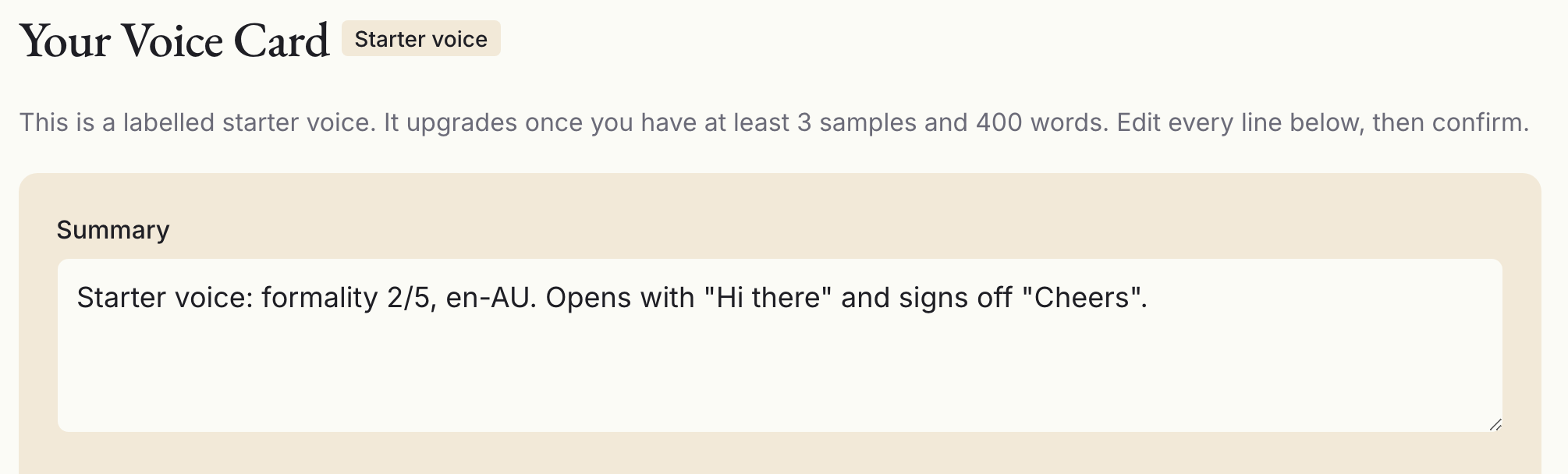
The card tells you which one you're holding, and exactly what it would take to move it on.
Those are the boundaries. The useful range is narrower.
| Sample length | What Voice can see |
|---|---|
| 25 to 60 words | Greeting, sign-off, formality. Rhythm is guesswork at this length |
| 150 to 400 words | The sweet spot. Sentence variation, paragraphing, how you build an argument |
| 400 to 1,200 words | Fine, and it adds structure habits, but one long piece can dominate three short ones |
Three samples of roughly 250 words each is a better card than one of 900 and two of 40. Not because longer is worse, but because a card built on one dominant piece is a card built on one day's mood.
Short samples aren't useless, they're just narrow. If your writing genuinely is short (SMS, chat, one-line product copy), tag them properly and add more of them.
Mixing registers, and what to do about it
The honest constraint first: Voice supports one voice per account. There's no second profile for your side project or your freelance clients. If you genuinely need two unrelated voices today, that's two accounts.
So how do you handle a mix? Most people don't have two voices, they have one voice at different volumes. Same habits, same sentence rhythm, same phrases, dialled up or down for the audience. That's a single card, and Voice already has the controls for the dial:
- Channel tags on samples and on each generation, so an email brief and a social brief come out differently.
- The formality nudge in the Studio, plus or minus two points from your card's baseline.
- The steer box, for one-off instructions on a single piece.
- The fidelity slider in rewrite mode, from "keep close" to "make it mine".
Build your card on your middle register, the one closest to how you write most of the time, and use those controls at the edges. A card built on the average of your friendliest and your stiffest writing is a card that's accurate about neither.
Where a second account genuinely earns itself is when you write for someone else's brand and the voice isn't a version of yours at all. That's not a register, it's a different person.
Read your Voice Card critically
The card is a first draft about you, and first drafts are wrong in places. Read it like an editor, not like a horoscope.
Ten fields are directly editable: the summary, tone, formality, region, greetings, sign-offs, favourite phrases, avoids, emoji, and the two learned lists. The measured half (average sentence length, its variation, opener diversity, contraction rate, punctuation habits) is read-only, because it's arithmetic on what you pasted rather than an opinion. If those numbers look wrong, the samples are wrong. Change the inputs, not the readout.
The four lines that are wrong most often:
- 1A sign-off you don't use. One sample where you were being unusually formal, promoted to a rule.
- 2Client vocabulary in your favourites. A product name or an industry term appearing three times reads as a favourite phrase. It's a noun that happened to be the topic.
- 3Formality a point too high. Nearly always because the samples skewed towards external writing. Everyone's outward voice is stiffer than their real one.
- 4Tone adjectives that flatter you. Read these with suspicion. If "authoritative" appears and you don't feel authoritative, one sample was you having a confident day.
Fix them and save. Every save writes a new version, keeps the old one, and the version history shows you a plain-English diff of any two versions, so nothing you do here is irreversible. If an edit made the output worse, revert to the version before it.
Fixing a card that sounds like someone else
If the drafts are wrong in a way that editing the card doesn't fix, the samples are the problem and no amount of card editing will save it.
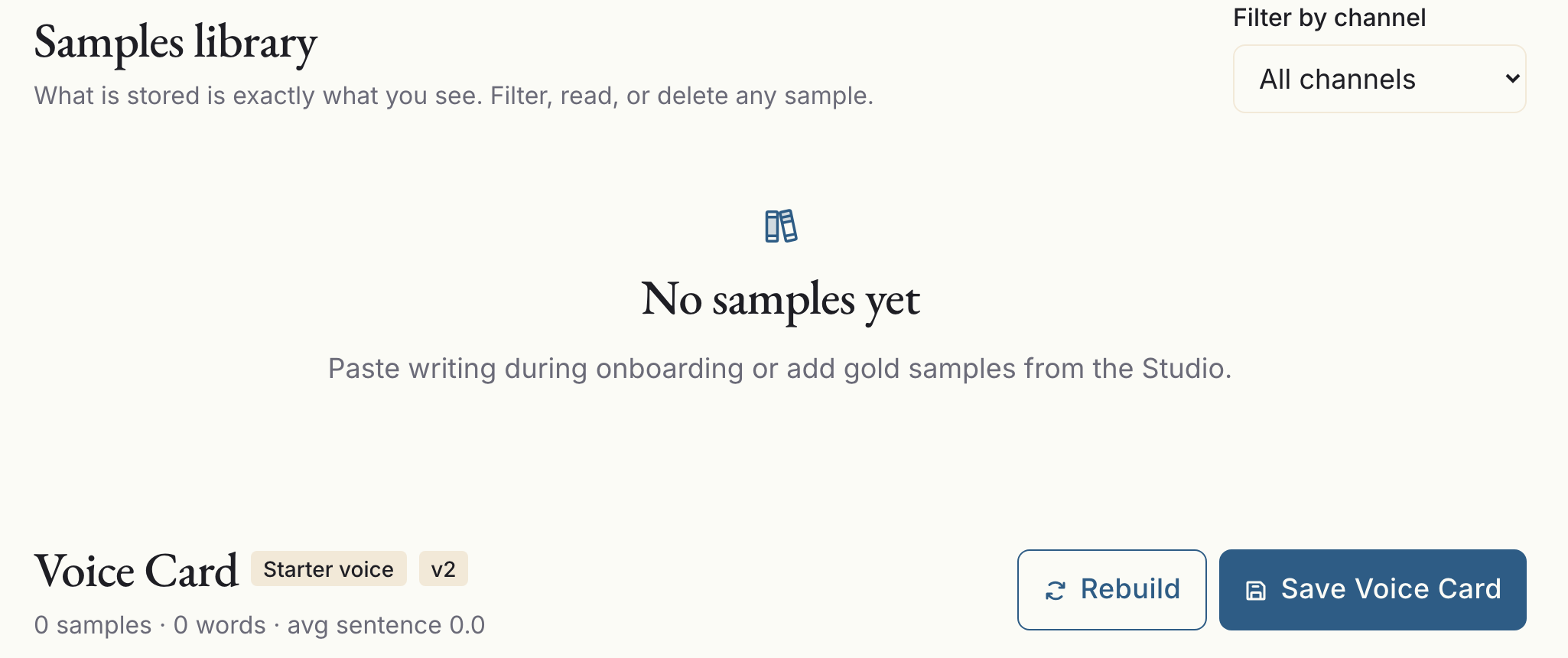
The header counts exactly what the card was built from, which on this account is nothing at all. Rebuild re-reads whatever is sitting in that list, so the list is the thing to fix first.
The repair sequence:
- 1Open the samples library and read what's in there. Nine times in ten the culprit is obvious the moment you see all three in one place. It's the one you pasted last because you were running out of things to paste.
- 2Delete the ones that aren't you. The library lets you read, filter by channel, and delete.
- 3Rebuild. That's the button that re-reads your current sample set and writes a new card version from scratch, plus whatever feedback you've given since the last one. Editing a card never re-reads your samples, and a rebuild doesn't preserve your hand edits: it's a fresh reading of the evidence. Your previous version stays in the history, so if the rebuild loses a line you'd fixed by hand, open the diff and put it back. Worth knowing before you rebuild rather than after.
- 4Save gold samples as you go. When an output does sound right, save it as a gold sample from the Studio. Gold samples carry more weight than pasted ones on the next rebuild, so approving good output is genuinely the fastest way to steer the card.
Worth knowing before you start: rebuilds are metered. The trial allows three of them in total, and every plan enforces at least ten minutes between rebuilds. So don't rebuild after every small change. Fix the whole sample set first, then rebuild once.
Feedback you give in the Studio (the "sounds off" chip, your edits, the outputs you accept) is collected as you work and folded into the card only when you rebuild. Never in the background, never without you pressing the button.
Re-running it later
Your writing moves. New job, new products, a stretch of writing for a different audience, and eighteen months later the card is describing a version of you that's retired.
Rebuild when something structural changes: a new role, a new brand, a deliberate shift in how you want to sound, or the day you notice you're editing every draft the same way. That last one is the real signal. Consistent edits mean the card is behind you, and consistent edits are also exactly what the learning history is capturing, so a rebuild at that point folds in work you've already done.
Between those moments, leave it alone. A card you rebuild constantly never gets a fair test.
Ten minutes, once
To recap the whole thing: three real pieces you wrote and nobody rewrote, in the register you want back, 150 to 400 words each, tagged honestly, from the last year or so. Read the card, fix the three or four lines that are wrong, save. Then go and write something and see whether it sounds like you.
If it doesn't, come back to the sample list before you come back to the card.
Not sure Voice is what you want at all yet? Unwrite GPT or Unwrite Voice: which one do you actually want? is the shorter decision, and one of the two answers is free.